
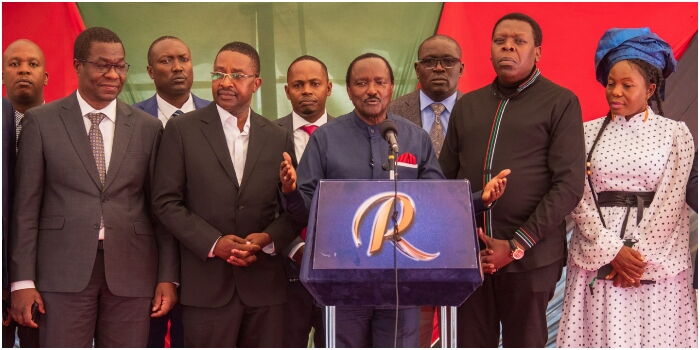
Azimio la Umoja has sharply criticized President William Ruto’s government, accusing it of proposing an exorbitant budget for the 2024/25 Financial Year. In a statement delivered by Wiper Party leader Kalonzo Musyoka, the coalition highlighted three specific budgetary allocations that they believe are misguided.
“We highlight the following misplaced allocations: one, the National Treasury has Ksh 26 billion more in the name of development; two, the State Department for Devolution has an increase of Ksh 2.6 billion in development expenditure; three, the State Department of Housing has been allocated an additional Ksh 72 billion, which is higher than that of 10 counties combined,” said Kalonzo Musyoka, flanked by other Azimio la Umoja co-principals.
Kalonzo called on Kenyans and other stakeholders to unite in condemning the Kenya Kwanza regime’s budget proposal. “In light of these grievous transgressions, we as a coalition urge the international community, civil society organizations, and concerned citizens both at home and abroad to stand in solidarity with Kenyans in condemning the Kenya Kwanza regime’s blatant disregard for the public good,” the statement read. According to the opposition, Ksh 1 trillion has been earmarked for what they term as “budgeted corruption” for the next financial year, while many Kenyans continue to struggle with poverty.
The opposition’s criticism follows the budget proposal presented by Treasury Cabinet Secretary Professor Njuguna Ndung’u in the National Assembly. The proposed budget ceiling of Ksh 4 trillion, a first in the country’s history, includes various allocations aimed at steering the republic toward economic recovery.
In the energy sector, the Treasury has proposed an allocation of Ksh 27 billion for enhancing the national electricity grid, Ksh 14 billion for tapping geothermal energy in Ol Karia, and Ksh 920 million for nuclear power initiatives.
For education, the Treasury has proposed Ksh 656.6 billion. This includes Ksh 358.2 billion for the Teachers Service Commission, Ksh 9.1 billion for supporting free education, Ksh 61.9 billion for free day secondary education, Ksh 5 billion for exam fee waivers, Ksh 30.7 billion for junior secondary school (JSS) capitation, and Ksh 13.4 billion for converting 46,000 JSS interns to permanent and pensionable terms. Additionally, Ksh 142.3 billion is allocated for basic education, Ksh 128 billion for higher education and research, and Ksh 30.7 billion for Technical and Vocational Education and Training (TVETs).
Azimio la Umoja’s stance on the proposed budget underscores their concern over the allocation of funds and the impact on key sectors amidst the nation’s economic challenges.
Recent Comments